


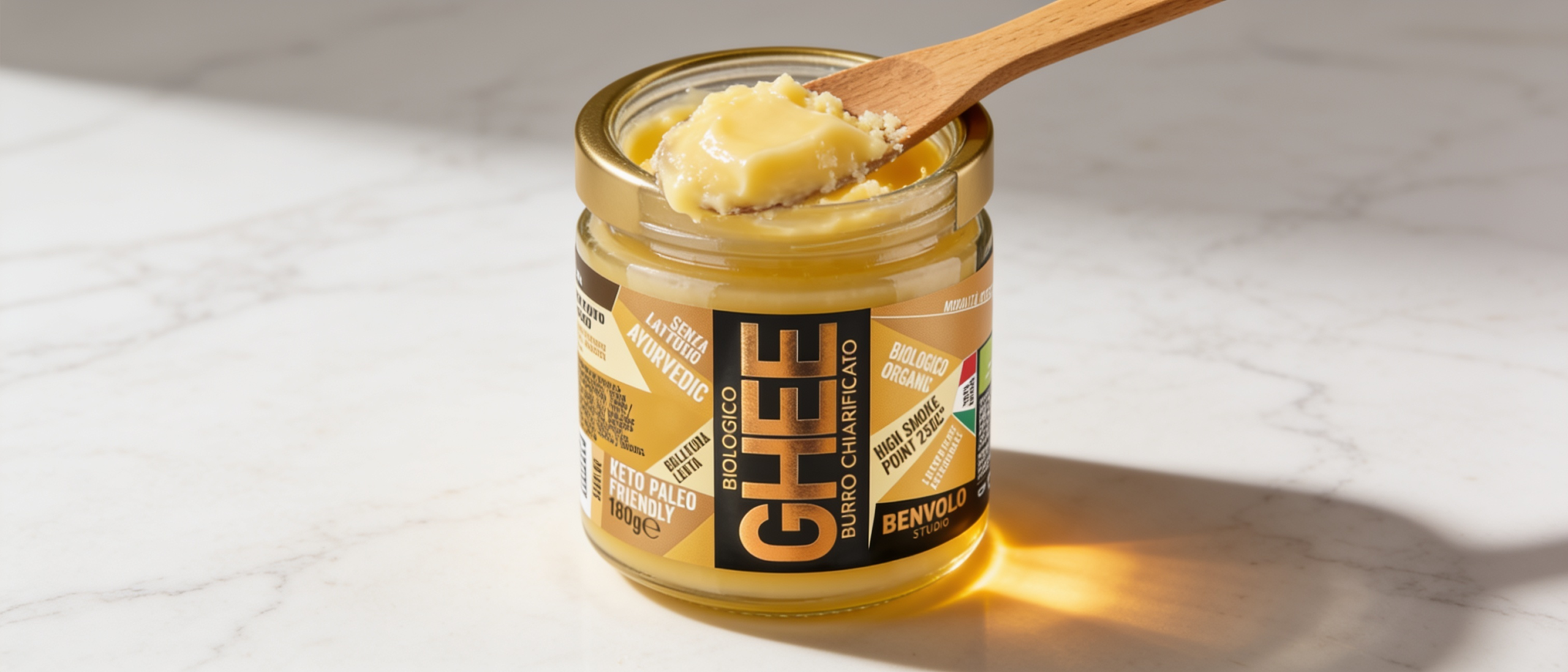
Ghee in Ayurveda:
Agni, Rasayana & 5,000 Years of Wisdom
From ancient Indian medicine to the modern table: why Ghee is the "king of fats" in Ayurveda and how its ritual use balances body, mind and digestion.
Ghee in Ayurveda: far more than just a fat
In Ayurvedic medicine — the world's oldest healthcare system, developed in the Indian subcontinent more than 5,000 years ago — Ghee holds a position of absolute privilege. It is not considered merely a dietary fat, but a Rasayana: a food that promotes longevity, nourishes deep tissues (Dhatu) and refines intellect (Buddhi).
Sacred texts such as the Charaka Samhita and the Sushruta Samhita devote entire sections to Ghrita (the Sanskrit term for clarified Ghee), defining it as the finest of the Sneha — the oleaginous media used in therapy. Its ability to penetrate the deepest tissues, carry active principles and nourish the nervous system made it irreplaceable.

"Ghritam Jīvanīyam, Varṇyam, Svaradam, Ojovardhakam" — Ghee is vital, improves complexion, the voice and increases Ojas (vital energy).
— Charaka Samhita, Sutrasthana, 3rd century BCEAgni: the digestive fire and Ghee's role
The concept of Agni (literally "fire") is central to Ayurveda. Agni is not merely digestion in the biochemical sense, but the organism's entire transformative capacity: metabolising food, processing emotions, discerning thought. When Agni is strong and balanced (Sama Agni), health flourishes. When it weakens or becomes imbalanced, disease arises.
Ghee acts on Agni in a unique and paradoxical way: it nourishes the fire without extinguishing it. It is Agnivardhan — that which increases Agni — but in a balanced manner. Unlike other heavy fats that dampen digestive fire, Ghee, due to its relative lightness and pure lipidic nature, stimulates the production of digestive enzymes and improves the absorption of all other nutrients.
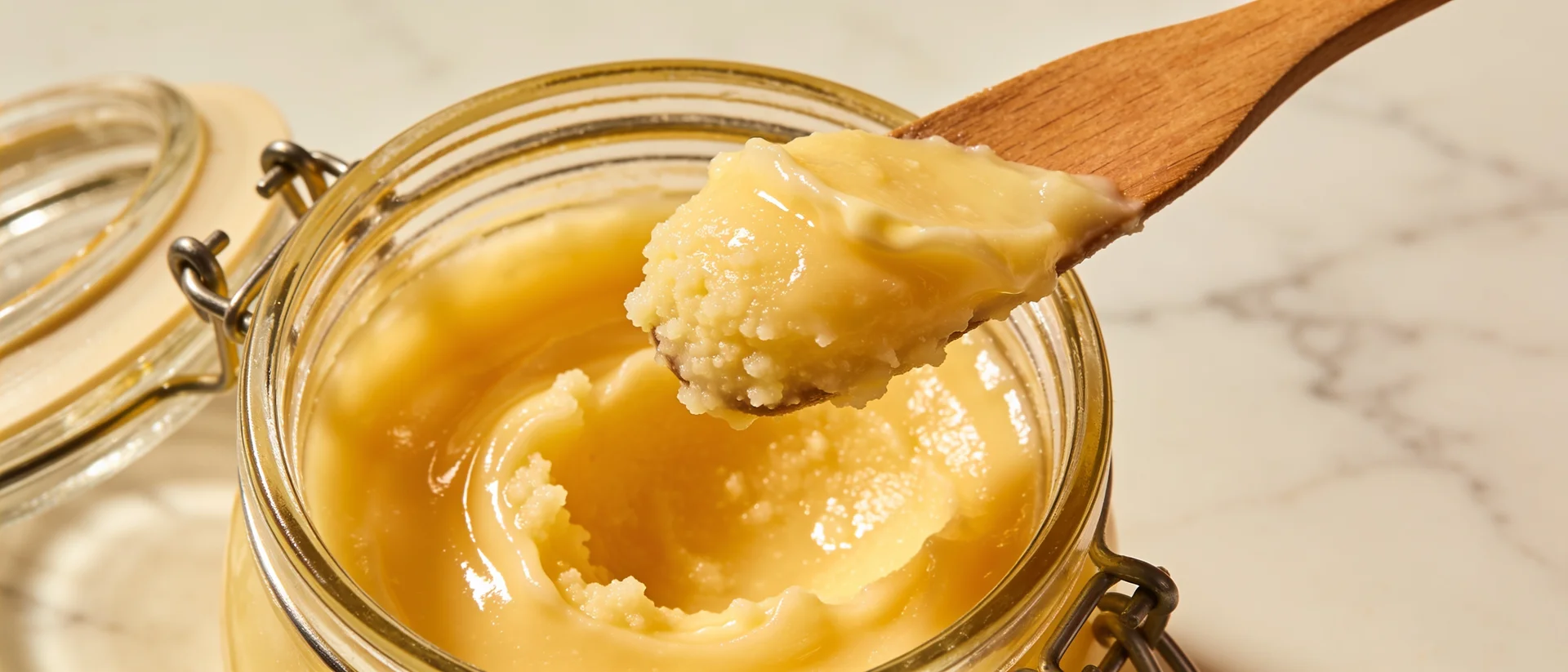
Anupana: Ghee as a spice carrier
One of Ghee's most sophisticated roles in Ayurveda is that of Anupana: a vehicle or carrier that amplifies and transports the active principles of herbs and spices into the deepest tissues. This concept is surprisingly aligned with modern pharmacology, which recognises how fats improve the bioavailability of fat-soluble compounds.
When turmeric is cooked in Ghee, for example, curcumin — its antioxidant active compound — becomes up to 7–8 times more bioavailable than turmeric consumed alone or in water.
| Spice / Herb | Active Compound | Traditional Ayurvedic Benefit |
|---|---|---|
| Turmeric (Haridra) | Curcumin (fat-soluble) | Anti-inflammatory, purifies blood, liver tonic |
| Black Pepper (Maricha) | Piperine | Amplifies Agni, improves absorption, antioxidant |
| Cardamom (Ela) | Cineole, Terpinene | Digestive, carminative, freshens breath, cardiac tonic |
| Ashwagandha | Withanolides | Adaptogen, reduces cortisol, strengthens Ojas |
| Shatavari | Steroidal saponins | Female tonic, balances Pitta, nourishes Rasa Dhatu |
Ghee and the Doshas: balancing Vata, Pitta & Kapha
According to Ayurveda, every individual is made up of a unique combination of three fundamental energies — the Doshas: Vata (air and space), Pitta (fire and water), Kapha (earth and water). Ghee is one of the rare tridoshic foods, capable of balancing all three Doshas.
Vata — Air & Space
Ghee is Snehana (oily, lubricating): nourishes Vata's dry tissues, calms the nervous system, promotes sleep, reduces anxiety and lubricates joints. Ideal for Vata-type constipation.
Pitta — Fire & Water
Ghee is Pittashamak: cools and calms excessive Pitta fire. Used in preparations for ulcers, acidity and inflammatory states. Its sweetness (madhura rasa) is key to pacifying Pitta.
Kapha — Earth & Water
Ghee stimulates Agni, which benefits Kapha for slow metabolism and digestion. Use in moderate amounts: small doses activate Agni but excess can increase Kapha. Ayurvedic rule: little and high quality.
Rasayana: Ghee as an elixir of longevity
The term Rasayana derives from "Rasa" (vital fluid, lymph, plasma) and "Ayana" (path). Rasayanas are substances that nourish Rasa — the first of the seven tissues (Dhatu) — and through it, nourish the entire tissue chain up to Ojas, considered the most refined essence of the body and the substrate of immunity and vitality.
Ghee is described as one of the Nitya Rasayana — a daily Rasayana — to be consumed regularly in small doses to maintain tissue vitality, preserve mental clarity and slow age-related degenerative processes.
"A body that abounds in Ojas does not know disease, does not feel cold, bears fatigue and hunger as if they were pleasures." Ghee, consumed mindfully, is one of the most direct paths to this state.
— Ashtanga Hridayam, 7th century CE🫙 Benvolio Organic Ghee 200 ml
Made from certified organic grass-fed butter, in an elegant reusable glass jar. Pure, golden, additive-free: Ayurvedic tradition in your modern kitchen.
🛒 Buy Benvolio Organic Ghee