


C8 MCT Oil (Caprylic Acid): What It Is, Properties, and How to Identify the Best Quality
What is C8 MCT Oil? C8 MCT Oil (Caprylic Acid or octanoic acid) is a highly purified medium-chain triglyceride composed of 8 carbon atoms, 100% extracted from coconut pulp. Unlike long-chain fats, it bypasses the lymphatic system and is absorbed directly via the portal vein by the liver, where it is converted into ketone bodies. Benvolio 1938 C8 MCT Oil is extracted by cold fractionated distillation without chemical solvents, is odorless and tasteless, and is packaged in protective dark glass.


What is Caprylic Acid (C8) and what is its molecular structure?
Caprylic acid, named octanoic acid according to IUPAC nomenclature, is a medium-chain saturated fatty acid with the chemical formula $CH_3(CH_2)_6COOH$ (or $C_8H_{16}O_2$). The conventional abbreviation C8 indicates the presence of a molecular structure formed by a linear chain of exactly 8 carbon atoms.
In nature, caprylic acid represents a minor fraction of the fats contained in coconut (about 6 to 7% of total oil) and in human or cow’s milk. When three caprylic acid molecules bind to a glycerol molecule via ester bonds, C8 medium-chain triglyceride (C8 MCT) is obtained.
Unlike long-chain fatty acids (LCTs, such as oleic or stearic acid, which contain 14 to 24 carbon atoms), the short chain of C8 reduces its lipid solubility and increases its partial water solubility, radically altering intestinal absorption kinetics in the human body.
How do the digestion and metabolism of C8 MCT Oil work in the human body?
The metabolic pathway of C8 medium-chain triglycerides differs substantially from that of all other dietary fats.
1. Gastric and Intestinal Absorption
Traditional fats (LCTs) require a long emulsification process in the duodenum by bile salts produced by the liver and hydrolysis by the pancreatic lipase enzyme. Once broken down, LCTs are re-esterified inside enterocytes (intestinal cells), incorporated into chylomicrons, and released into the lymphatic system before reaching the general bloodstream.
C8 MCT Oil almost entirely bypasses this sequence:
-
Does not require emulsification by bile salts.
-
Does not require complex breakdown by pancreatic lipase.
-
Crosses the intestinal mucosa via passive diffusion.
2. Direct Hepatic Transport and Ketogenesis
Once absorbed by enterocytes, C8 is directly released into the hepatic portal vein system, reaching the liver within a few minutes.
Inside hepatocytes (liver cells), C8 molecules enter the mitochondria independently of carnitine (the protein transporter required for the entry of long-chain acyl-CoA). In the mitochondria, caprylic acid undergoes rapid $\beta$-oxidation, breaking down into Acetyl-CoA units. The excess Acetyl-CoA produced by C8 fuels the hepatic ketogenesis pathway, leading to the synthesis of the three primary ketone bodies:
-
Acetoacetate
-
$\beta$-hydroxybutyrate (BHB)
-
Acetone
The ketone bodies generated in this way are released into the bloodstream, where they can easily cross the blood-brain barrier and be used by peripheral tissues and the central nervous system as an alternative cellular energy source to glucose.
What are the exact nutritional values and composition of C8 MCT Oil?
Pure C8 MCT Oil is a high-energy-density food, free of macronutrients other than lipids, and free of water-soluble micronutrients or minerals.
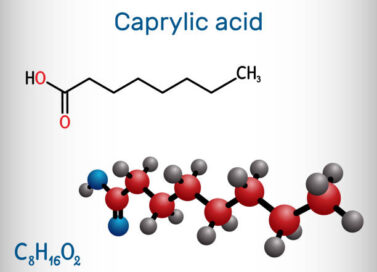
Molecular structure of Caprylic Acid (C8H16O2): highlighting the linear 8-carbon chain and the three-dimensional model.
How is C8 MCT Oil extracted and purified without using chemical solvents?
Caprylic acid is never found in a pure state in nature, but is always bound to other fatty acids within the lipid matrix of coconut or palm. The industrial separation process determines the organoleptic quality and safety of the final product.
The Cold Mechanical Fractionated Distillation Process
-
Extraction of Raw Coconut Oil: The dried pulp of the coconut (Cocos nucifera) undergoes mechanical pressing to extract raw vegetable oil.
-
Hydrolysis (Ester Cleavage): Coconut oil is combined with water under controlled temperature and pressure to break down triglycerides into individual free fatty acids and glycerol.
-
Physical Fractionated Distillation: By taking advantage of the different boiling points of individual fatty acids (C8 boils at lower temperatures than C10 and C12), the mixture is heated under vacuum. The caprylic acid (C8) vapors rise along the fractionating column, are condensed, and are separated with a purity ≥ 95%.
-
Natural Re-esterification: The purified caprylic acid is mechanically recombined with vegetable glycerol to rebuild the triglyceride structure (C8 MCT).
-
Deodorization and Filtration: The product is filtered through natural activated carbon to remove any aromatic residue, yielding a completely odorless and tasteless oil.
Transparency note: Many industrial manufacturers use synthetic chemical solvents (such as hexane or acetone) to accelerate fractionated extraction. Benvolio 1938 C8 MCT Oil uses exclusively cold physical distillation, free from synthetic chemical reagents.
How to recognize a quality C8 MCT Oil: Raw materials, glass bottle, and certifications
Not all oils labeled as “MCT” on the market offer the same guarantees of food purity and safety. To make an informed choice, four critical parameters must be checked:
1. Origin of Raw Material: 100% Coconut vs Palm Oil
The cheapest raw material for extracting MCTs is palm kernel oil (extracted from oil palm seeds). However, oil palm cultivation is frequently associated with deforestation issues and high environmental impact. WizeBite C8 MCT Oil guarantees exclusive origin from coconuts, ensuring a sustainable supply chain free from palm derivatives.
2. C8 Purity Grade (Label Assay)
Generic MCT oil often contains variable mixtures of C8 (50-60%) and C10 (30-40%), with possible traces of C12. A Premium C8 supplement must state on the label or certificate of analysis a percentage of Caprylic Acid equal to or greater than 95%, reducing the presence of C10 to below 5% and completely eliminating C12.
3. Packaging Material: Dark Glass vs Plastic
Pure medium-chain triglycerides possess a strong solvent capacity toward certain plastic polymers (such as PET or HDPE). Prolonged storage of MCT oil in plastic bottles carries the risk of leaching phthalates, bisphenol A (BPA), or microplastics into the liquid. Furthermore, direct sunlight triggers lipid peroxidation reactions.
For these reasons, Benvolio 1938 packages C8 MCT Oil exclusively in dark glass bottles (UV-resistant), an inert material that releases no chemical substances and preserves the fat’s molecular structure unchanged.
4. Tradition and Laboratory Testing
Choosing a historic brand like Benvolio 1938—active in selecting and processing vegetable oils for nearly a century—guarantees rigorous laboratory controls on every production batch, verifying the absence of heavy metals, pesticides, mycotoxins, and solvent residues.
Frequently Asked Questions about C8 MCT Oil (FAQ)
Virgin coconut oil is a raw fat containing approximately 50% lauric acid (C12), 6-7% C8, and 4-5% C10, and is solid below 25°C with a strong coconut aroma. C8 MCT Oil is a concentrated and purified extract made up of over 95% pure caprylic acid (C8). It remains liquid at all times, is odorless and tasteless, and is absorbed by the liver much faster than raw coconut oil.
C8 MCT Oil is a safe and highly tolerated food supplement. However, when consumed in high doses by individuals who are not used to it (e.g., more than 20-30 ml at once), it can cause a rapid acceleration of bowel motility, abdominal cramps, or mild episodes of osmotic diarrhea. To avoid these issues, simply begin supplementation with low doses (1 teaspoon or 5 ml per day) and gradually increase the amount over a period of 7 to 10 days.
No. C8 MCT Oil has a relatively low smoke point of around 160°C. Reaching or exceeding this temperature causes thermal degradation of the caprylic acid molecules, as well as the formation of smoke and acrolein. C8 MCT Oil should be used exclusively raw—added to hot beverages (coffee, tea), smoothies, or poured directly over cooked dishes off the heat.
Fonti esterne istituzionali e scientifiche