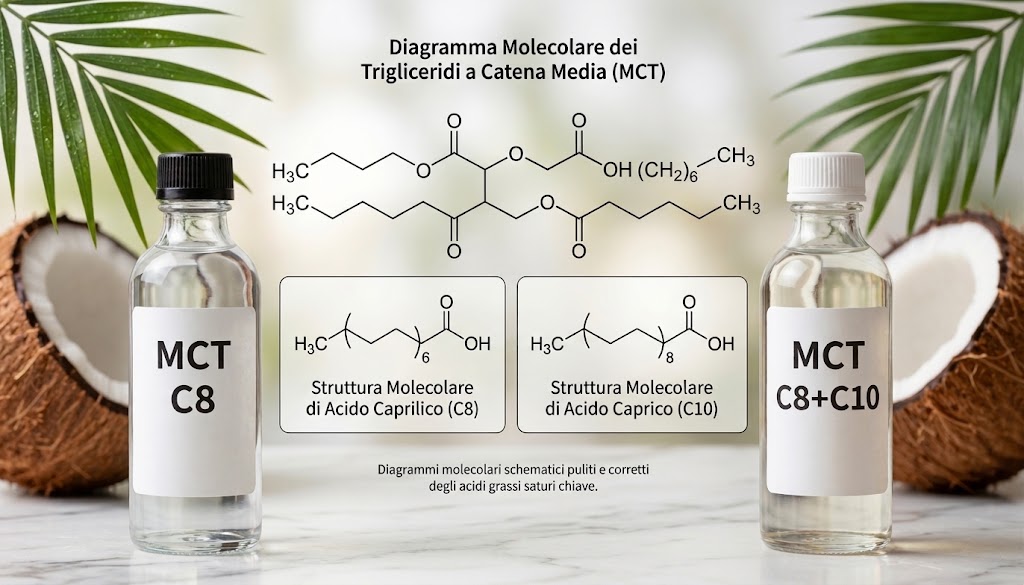


C8 vs C10 vs C12: What Is the Difference Between Caprylic, Capric and Lauric Acid?
C8, C10 and C12 all belong to the family of saturated medium-chain fatty acids, but they do not behave the same way in the body. The most obvious structural difference is the number of carbon atoms; this characteristic progressively influences digestion, intestinal absorption, transport via the portal vein or the lymphatic system, and hepatic metabolism.
The comparison is particularly important when contrasting coconut oil, generic MCT oils and high-concentration C8 caprylic acid formulations.
Caprylic Acid
It is the medium-chain fatty acid with the most characteristic behaviour of rapid MCTs: it is largely absorbed into the portal circulation and reaches the liver quickly.
Capric Acid
It retains a typical MCT profile, but the increased chain length progressively alters its digestive and metabolic behaviour compared to C8.
Lauric Acid
It is the main fatty acid in coconut oil and behaves more like a long-chain fatty acid in a significant portion of its intestinal transport.
1. The Fundamental Difference: The Number of Carbon Atoms
The labels C8, C10 and C12 indicate the number of carbon atoms present in the fatty acid chain. Caprylic acid is therefore a C8:0 fatty acid, capric acid is C10:0, and lauric acid is C12:0.
The systematic nomenclature is, respectively, octanoic acid, decanoic acid and dodecanoic acid. All three are saturated fatty acids: the ":0" suffix indicates the absence of double bonds in the carbon chain.
The relationship between structure and metabolism is not, however, a simple "MCT vs LCT" switch. There is instead a gradient that depends on chain length. In general, as chain length increases, so does the tendency of the fatty acid to be incorporated into enterocyte triglycerides and chylomicrons, resulting in greater involvement of the lymphatic system.
2. C8, C10 and C12 Comparison Table
| Molecular / Biological Parameter | C8:0 Caprylic Acid | C10:0 Capric Acid | C12:0 Lauric Acid |
|---|---|---|---|
| Systematic nomenclature | Octanoic acid | Decanoic acid | Dodecanoic acid |
| Carbon atoms | 8 | 10 | 12 |
| Molecular formula | C8H16O2 | C10H20O2 | C12H24O2 |
| Presence in coconut oil | Approx. 5–10% | Approx. 5–8% | Approx. 46–54% |
| Portal transport | Predominant | Predominant | Significant, but less predominant |
| Lymphatic transport / chylomicrons | Limited | Greater than C8 | Much more relevant |
| Dependence on bile and pancreatic lipase | Reduced compared to LCTs | Reduced compared to LCTs | Greater than C8/C10 |
| Hepatic oxidation | Very rapid | Rapid | Slower / intermediate |
| Dependence on carnitine shuttle in the liver | Very low | Low | Greater than C8 |
| Benvolio C8 Formulation |
100% C8 according to the official description currently published |
Not declared as a main component | Absent in the declared formulation |
3. Why Does Chain Length Affect Absorption?
Dietary fats are not all absorbed in the same way. Long-chain triglycerides are normally hydrolysed in the small intestine, emulsified with the help of bile salts, organised into mixed micelles and subsequently re-esterified within the enterocytes.
Medium-chain triglycerides, by contrast, have physicochemical characteristics that allow for faster digestion and absorption. The literature describes a lower dependence on bile acids and pancreatic lipase compared to long-chain triglycerides.
Once freed from the fatty acids esterified to glycerol, C8 and C10 can be transported largely to the liver via the portal circulation. As chain length increases, however, a greater proportion can be re-esterified in the enterocytes and transferred via chylomicrons and the lymphatic system.
4. C8: Why Is Caprylic Acid Considered the Fastest?
Caprylic acid (C8:0), also known as octanoic acid, has eight carbon atoms. It is one of the most commonly used components in high-concentration MCT formulations.
After hydrolysis, C8 shows a strong tendency to be transported via the portal vein to the liver. This reduces the need to follow the typical long-chain triglyceride pathway through chylomicron formation and the lymphatic system.
A review on MCT applications reports that almost all C8 can be directed to the portal circulation, while the portal fraction tends to decrease as chain length increases. This finding is important because it demonstrates that the difference between C8, C10 and C12 is not merely nominal, but has a physiological basis.
Once it reaches the liver, C8 can be rapidly activated and subjected to mitochondrial β-oxidation. Its oxidation is relatively independent of the carnitine transport system that controls the entry of long-chain fatty acids into the mitochondrion.
5. C10: Is Capric Acid Similar to C8?
Capric acid (C10:0), or decanoic acid, has a chain of ten carbon atoms. It is also a typical component of commercial MCT oils.
C10 retains many of the metabolic characteristics of MCTs: a significant proportion is absorbed and transported via the portal vein and can reach the liver rapidly.
However, the increase in chain length compared to C8 progressively alters the distribution between the portal and lymphatic routes and may modify metabolic kinetics.
For this reason, it is not correct to simply state that "C8 and C10 are identical". Both are typical MCTs, but C8 generally shows a faster profile and a greater ketogenic capacity than C10.
A review specifically dedicated to the ketogenic effect of different MCTs reports that C8 produces a greater increase in ketones than C10 and C12 under comparable experimental conditions.
6. C12: Why Is Lauric Acid a Special Case?
Lauric acid (C12:0), or dodecanoic acid, represents the longest chain commonly defined as "medium-chain". From a structural standpoint it is included among MCFAs in many publications, but its physiological behaviour is significantly different from that of C8.
C12 is in fact very abundant in coconut oil. A scientific review reports values in the range of 46–54% of the fatty acids in coconut oil, while C8 and C10 are present in much smaller proportions.
The key point is that C12 should not be treated as if it were metabolically identical to C8. Its greater length favours increased incorporation into triglycerides and chylomicrons, and therefore a greater contribution of the lymphatic route.
It is more accurate to say that C12 represents a medium-chain fatty acid with intermediate physiological characteristics. It is not necessary to turn the chemical classification into an absolute classification of biological behaviour.
7. Portal Vein vs Lymphatic System
The difference between these two routes is one of the main reasons why MCTs are considered a metabolically distinctive lipid source.
Predominantly portal route
C8 is largely absorbed and transferred to the liver via the portal circulation, often as a free fatty acid bound to albumin.
Predominantly portal route
C10 also shows a strong contribution from the portal route, but the behaviour is less extreme than C8 and is more influenced by chain length.
Greater lymphatic component
C12 shows a greater tendency than C8 and C10 to be re-esterified in the enterocytes and transported via chylomicrons and the lymphatic system.
8. C8 and Ketogenesis: Why Is the Response Different?
The liver can convert some of the acetyl-CoA produced by β-oxidation into ketone bodies, especially when metabolism shows greater availability of fatty acids and a hormonal context favourable to ketogenesis.
MCTs, and in particular C8, have a high capacity to increase ketone production compared to long-chain fats. This is one of the reasons why MCTs are also used in the context of ketogenic nutrition and specific clinical nutrition settings.
Comparative research shows that C8 is particularly ketogenic. In a review of available studies, the ketogenic effect of C8 was found to be greater than that of C10 and C12.
This does not mean, however, that taking C8 automatically produces "instant energy" perceptible by every individual. From a scientific standpoint, it is more accurate to speak of rapid metabolic availability and greater ketogenic potential.
9. The Role of Carnitine in Metabolism
Long-chain fatty acids require the so-called carnitine shuttle to cross the inner mitochondrial membrane and reach the matrix, where β-oxidation takes place.
Medium-chain fatty acids, especially in the liver, have a much lower dependence on this system. This allows C8 and C10 to be oxidised more directly.
It is important, however, not to turn this characteristic into an absolute statement that "C8 never uses carnitine". Physiology varies depending on the tissue, substrate concentration and metabolic state. The more accurate distinction is that their hepatic oxidation is far less dependent on the carnitine shuttle than that of long-chain fatty acids.
10. How Much C8, C10 and C12 Does Coconut Oil Naturally Contain?
Coconut oil is often associated with MCTs because it contains medium-chain fatty acids. However, coconut oil and MCT oil are not synonyms.
The composition of coconut oil is dominated by lauric acid. A review reports approximate values of:
These values can naturally vary depending on the cultivar, the origin of the raw material, processing conditions and the analytical method used. It is therefore not appropriate to use a single percentage as the universal composition of any coconut oil.
11. Why Is an MCT C8 Oil Different From Coconut Oil?
An MCT oil is produced through industrial processes that allow specific fatty acid fractions to be concentrated. Commercial formulations are predominantly based on C8 and C10.
The result is a lipid matrix very different from traditional coconut oil, in which C12 generally represents the dominant fraction.
High-Purity C8 MCT Oil
- High concentration of C8 caprylic acid.
- Rapid absorption compared to long-chain fatty acids.
- Strong availability for hepatic metabolism.
- High ketogenic potential compared to C10 and C12.
- Generally neutral organoleptic profile in refined formulations.
Coconut Oil
- High presence of C12 lauric acid.
- Also contains C8 and C10, but in much smaller quantities.
- Different metabolic profile from a purified C8 MCT oil.
- A complex food product, not a standardised MCT formulation.
- Composition varies depending on the raw material and processing.
12. Pure C8 vs C8/C10 Blends
Not all MCT oils on the market have the same composition. Some products are formulated with a mixture of C8 and C10, while others are designed to have a very high concentration of C8.
A C8/C10 blend is not necessarily an "inferior" product: the choice of composition depends on the nutritional objective, the formulation and the price. It is important, however, not to confuse a high-purity C8 product with a generic MCT oil.
Composition should be assessed through the label, the technical data sheet and, where available, the product's analytical certificate.
13. The Benvolio Ketobrain WizeBite MCT C8 Case
WizeBite MCT C8 Pure KetoBrain Oil is a product composed of 100% C8 — an MCT oil derived from coconut intended, among other uses, for the ketogenic diet and for use in coffee, smoothies and salads.